

I don’t watch much TV; in fact I have not had cable for my entire adult life. I guess I’m sometimes left out of the “did you see X on Y show last night?” conversations but I somehow manage to soldier on.
One think that I really despise about the boob tube are those darn satellite dishes. In a historic neighborhood like mine I can think of nothing more ridiculous than “The Dish” hanging allover historic buildings. I have long thought there has to be some stealth version of these things.
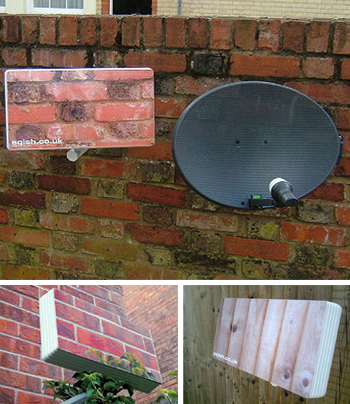
Well its here The Squish is a slick alternative to the standard ugly dish. It’s a slick little satellite dish disguised with a custom sticker to blend in with your structure. It is one of those things that has me saying once again, could no one really think of this sooner? It is a great way lessening the visual impact of urban dish gardens everywhere.
We are big fans of prefab here at Small Space Living. And after having spent my first weekend of the summer at the cottage, I am thinking of get-a-ways.
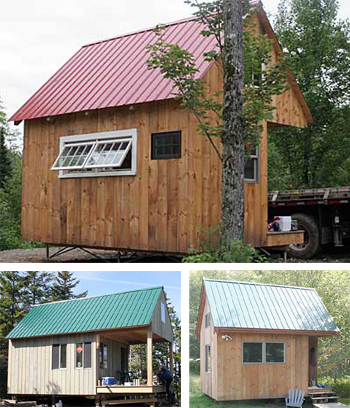
Bungalow in a Box builds small ready to assemble Bungalow kits. While not exactly a entirely pre-built structure like many of the prefab projects we have covered, it has a lot of promise.
You assemble the Bungalow in a Box in place on your foundation in one or two days. Now I’m thinking that perhaps Norm Abram would be able to have one up by lunch, but it may take a lesser carpenter slightly longer. The kit does seem to be set up so anyone with moderate skill could build one.
Bungalow in a Box kits are the full finished exterior of the structure allowing you the ability to customize the interior. The kits are perfect for studios, backyard offices and weekend get-a-ways. The best part is the price tag — starting at $13,700 for the 12x16 foot model they should be accessible to most.
The Italians have always been the cutting edge of design and architecture. So it stands to reason that their entries into the prefab market would be stylish and beautiful.
The Joshua Tree by Hanger Prefab Group definitely delivers a healthy dose of Italian Style. The Joshua Tree is a stunning steel panel covered prefab vacation home. The grey exterior is a stark contrast to the warm wood of the interior. The interior is constructed of pale wood reminiscent of a beach cottage.
The design is simple yet elegant and unique enough to set itself apart from other prefabs in its size category. Billed as a “mountain refuge” at the Milan Furniture Fair, the Joshua Tree would be a welcome addition to the prefab market stateside. The Joshua Tree is being marked by Holiday Homes Design.
I’m encouraged to see the international market producing spectacular prefabs. I will have more information on the Joshua Tree as soon as more English information becomes available. Via Dwell.
Photo Credit Michael Weschler for The New York Time
A recent New York Times article “A Global Sweep On a Tiny Budget” by Elaine Louie showcases a fantastic Greenwich Village apartment.
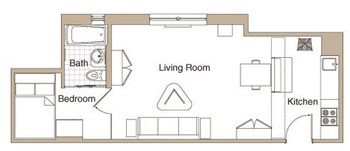
The apartment, a 435 square foot studio, was transformed into a surprisingly spacious-feeling one-bedroom apartment. The project is an example of the remarkable possibilities in small space living. The entire remodel was accomplished with a $41,000 budget. Not inexpensive, but very reasonable for New York.
The apartment is able to achieve much in its relatively small space. The kitchen is open and nicely equipped. The living room appears more spacious than possible.
All in all it is another great example of living well in a smaller space.
Way back in January I did a post on Apartment Therapy’s Small Cool 2007 contest. It is a marvelous event where owners and renters submit photos of their small apartments. There are prizes for the winners and tons of eye candy and free ideas for the rest of us.
The contest brings out the best of the beautiful small living spaces. Last year I spent untold hours scrolling through sideshows of some pretty incredible dwellings. The entire contest is just fabulous — there is no single place where you can see so many stunning small designs.
Well its that time again the 2008 contest is underway. This year the deadline for entry is April 14th. I am somewhat expecting that deadline to be extended, as there are not so many entries this year.
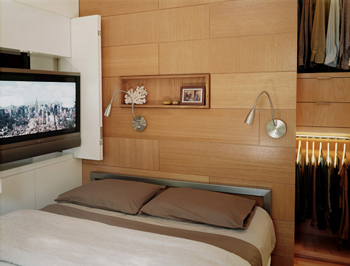
So far I love “Luca’s Surplus of Storage & Light”. It is truly a marvel of small space living. At just 400 square feet it certainly qualifies for small space, but the balance of light and perfect built-ins make it seem much larger. As amazing as it sounds, this tiny apartment has a walk-in-closet. I also love the built-in storage separating the living area from the bedroom. The wall of storage contains the apartments AV equipment, including a flat screen TV that can pivot to be viewed from either room.
I’m sure by the time Apartment stops accepting entries there will be some additional stunning spaces. I’ll keep you posted.
It’s nice to see relevant architecture available to the masses. Very often striking architecture comes at striking prices.
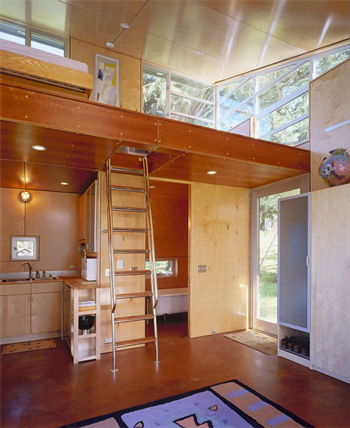
I have been watching the C3 Cabin for several years. Designed by Vandeventer + Carlander Architects, the C3 was originally designed as a weekend retreat for a couple in Washington State. In 2006 it won the AIA/Sunset Magazine Merit award. The plans were later made available at a cost of $2,000.
Making plans available for mass production is a significant step for an architectural firm. Selling plans for structures carries with it considerable liabilities and expense, which are passed along in the purchase price.
So why am I talking about a several year old design? For several reasons, not the least of which is a price drop of the plans to $850. This is a fantastic price for an award winning design.
The cabin is a perfect illustration of small space living with big style. The foot print of the cabin results in an interior square footage of 352 on the fist floor with an additional 128 in the loft. The interior is designed with the kitchen and bath on the first caped by the sleeping loft.
The design of the cottage encompassed three primary goals. First, to provide the space required for an extend stay cabin with a minimal footprint. Second, provide a quality of space and abundant natural light not typically found in a structure of this size. And third, the structure needed to allow for simplicity of construction and maintenance. The C3 hits a home run all three points.
The cabins exterior is constructed of low cost fiber cement and metal panels. These materials have a low initial cost and minimal long-term maintenance.
The cabin has that light airy look and feel of a well-designed space. The natural light and interior height trick one into believing the C3 is a far more spacious structure.
Stairs are hard. Not walking up or down them, but rather integrating them into a small floor plan. Our home has a unique set up with the stairs floating in the center of our home. There are no walls around the stairs on the first floor, which makes that level seem bigger than that of similar homes.
Floating or not, they very much limit the area around them. It is our intention to move the stairs back against the wall to open up more precious floor space. If it were one set of stairs it would be easy, but we also need the basement, second floor and attic. I suppose when the time is right we will consult an architect.
I do however find myself looking at the many available stair options on the internet. I am constantly looking for that perfect stair and how it could integrate into our home.
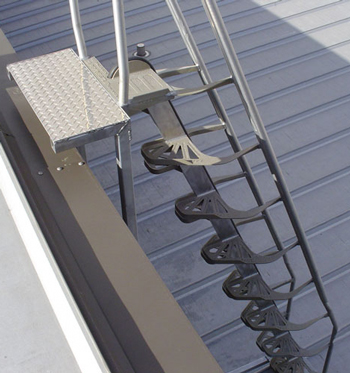
The picture at the top of the post is an industrial indoor or outdoor aluminum alternating-tread unit that I have been seeing everywhere. It is in projects in several books I own and I remember seeing it in no less than four magazine spreads lately. If I lived in an ultra slick bachelor pad, I’d consider slapping it on every floor. The wife would never go for it and I’m sure after one slip I’d hate it too.
I do come across cool stairs very often and here is a gallery of my favorites. Have a great stairs in your home? I’d love to see them — send it my way.
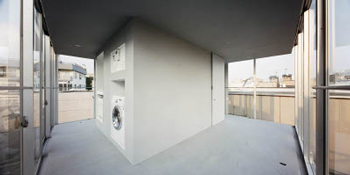
How small is your apartment? I’m going to guess that it is slightly larger than these 82 square foot units designed by architect Kumiko Inui.
In Tokyo the average apartment is 774 square feet. With land for new construction in very limited supply, many smaller lots that had previously been over looked are more frequently being utilized. This apartment complex is one such structure.
The building is a feat of architectural design. The apartments may be small, but floor to ceiling windows let in natural light and provide expansive views. I can’t imagine much furniture in these spaces. Truly an example of small space living, this is the smallest apartment building I have ever seen.
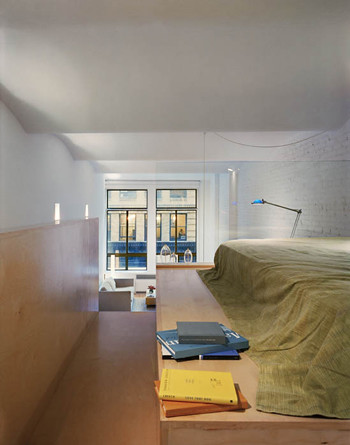
The Interlocking Loft is great example of lofty living in a small space. The space for this loft is far from spacious, but Kyu Sung Woo Architects were able to pack in a lot of living while retaining an open airy feel.
The space has a waved ceiling that, at its low point, is 11 feet 10 inches and in the high points is 12 feet 3 inches. This space did not allow for two full height levels, so the architects incorporated three separate half-height levels into the design. Tucked into the highest points of the ceiling are to separate sleeping areas joined by a catwalk. The architects used the area under the upper areas for closets and spaces not requiring full height.
The space truly interlocks perfectly. In one of sleeping areas there is a raised sleeping platform; the underside of which creates more headroom in the kitchen area.
Today the CDC has reported that the air inside the trailers used to house displaced Hurricane Katrina victims contain toxic levels of formaldehyde. The levels inside the trailers can cause respiratory and other health problems.
Understanding fully the difficulties of housing such a large number of families — I’m I'm still left scratching my head. Hurricane Katrina hit the US in August of 2005. Why are people still living in trailers? This is baffling to me when there are a vast array of solutions to these housing dilemmas that are just not being utilized. Instead of adding to the chorus of voices criticizing the missteps of the past, I thought we would look at some of the options to improve the situation.
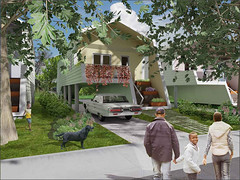
Brad Pitt and the Make it Right 9 project plans to build 150 homes in the lower 9th Ward of New Orleans. They are off to a great start with 78 of 150 homes financed. You can donate to this cause on the Make it Right website and remember it’s not a hand out, it’s a hand up. There are some great designer green homes going up in the 9th Ward. They are really quite innovative including being built on slightly elevated stilts to aid in future flood survival. Check them out.
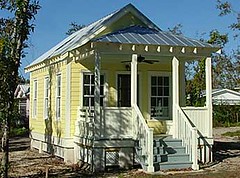
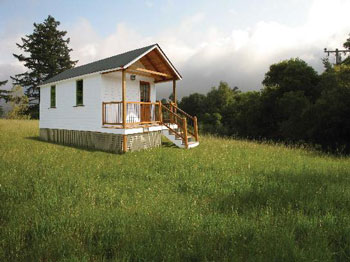
I have touched on Katrina Cottages in a previous post, but they certainly warrant a more in-depth look here. The Katrina Cottage 1 at 308 square feet is far from being spacious. It is, however, a real permanent dwelling that can be built for $70,000. The cost of this original cottage is less than that of the toxic trailers. It was intended to be a very inexpensive, attainable structure that could be later attached to a larger home. The plan is a great solution to get people in homes and allow them the opportunity to add more space later. These cottages are also available in a verity of sizes from the original 308 square foot up to a fully accessible version at 1,182 square foot. I also like that you can buy the kits — some are just pre-cut lumber and others are panelized prefab structures or the plans. The best part is you can buy them at your local Lowe’s.
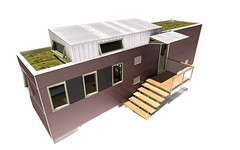
The miniHome is a unique little structure. It is somewhere between ultra hip prefab home and a doublewide. This diminutive dwelling really is an amazing feet of design and architecture. The miniHome integrates all the newest in sustainable home technology in one clean ready to live in structure. It has passive solar panels, solar panels, led lighting and composting toilets. All this and it is a travel trailer although not intended for continual travel placing and relocating it are quite simple tasks. All and all it is a well laid out and comfortable looking space for its mere 340 square feet. It has one of the most workable kitchens I have seen in similarly sized dwellings.
Designers Andy Thomson and Dan Hall and Northlander Industries are ramping up a production run to begin in the spring of 2008. So often we see stunning designs that are just that designs that never go into real production. Well the miniHouse is available now so if you are interested check it out.
So Apartment Therapy is a great site. It is filled with all sorts of fantastic stuff. There are cool products; great ideals and photo tours of some pretty spiffy apartments. Once a year they have the Smallest, Coolest Apartment contest 2007 was the 3rd annual contest. It is an amazing collection of beautiful living spaces. So yes I know it was last year but I’m looking forward to this years entries and looking back one more time. If it’s new to you check it out.